
Introduction to PDF Credentials
Academic achievements no longer need to exist only on paper.
Educational institutions are increasingly embracing digital transformation to make the issuance, sharing and verification of qualifications faster, more efficient and more accessible.
Organisations looking to digitalise their certificates typically choose between two approaches: PDF documents or digital credentials. Whilst both allow institutions to issue digital copies of qualifications, there are key differences in how they protect award integrity, support verification and maintain issuer control.
If you’ve ever downloaded a printable document, sent an invoice or viewed an online brochure, it was likely a PDF. PDFs have become one of the most widely used electronic document formats in the world because they can be viewed consistently across devices and easily shared. Adobe estimates there could be more than 3 trillion PDFs in the world today, making it the third most popular file format on the internet (after HTML and XHTML).
While PDFs are excellent for many use cases, they offer limited protection against alteration, duplication and unauthorised sharing. Once a PDF has been downloaded or shared, the issuing institution loses visibility and control over how it is used. For qualifications, awards and certificates, this creates significant risks for universities, awarding organisations and professional bodies, making it more difficult to prevent fraud and protect the long-term integrity of their awards.
Why are PDF credentials vulnerable to fraud?
As we’ve written about previously, certification fraud is an ongoing challenge for the education sector, posing significant risks to both document integrity, institutional reputation and trust.
Preventing fraud involves more than protecting against document tampering. Institutions must protect the long-term integrity of their qualifications, provide simple verification processes and maintain confidence in the value of their awards years after they are issued.
This is where the limitations of PDF credentials become apparent. While they may provide an electronic version of a certificate, they do not inherently provide proof that a qualification remains valid, has not been altered or is being presented by the legitimate holder. As a result, institutions often need to rely on additional manual verification processes to confirm authenticity.
Easily created and modified
The primary risk of using PDFs for credentials is that they can be easily created by almost anyone with even the most basic software.
Depending on how they are created and protected, PDFs can often be copied, edited and modified using paid tools like Photoshop or Illustrator to alter grades or even create counterfeit documents.
The widespread availability of free PDF editors has made document editing easy and accessible. Type “free pdf editor” into Google and 1,220,000,000 search results appear. Whilst this has great use cases for other areas of business, for certification and awards, it is an open door for counterfeiting and alteration fraud.
And it doesn’t end there.
Lack of control after issuance
Once a PDF has been created, sent, downloaded and shared, the real challenge is that the issuing institution loses control over what happens next. Multiple copies can be stored, forwarded, uploaded to websites or shared between third parties without the issuing organisation ever having visibility into how the document is being accessed and used.
Although PDFs can be password-protected and digitally signed, these controls can be bypassed in some circumstances, and they do not prevent authorised recipients from making copies or sharing the document once access has been granted.
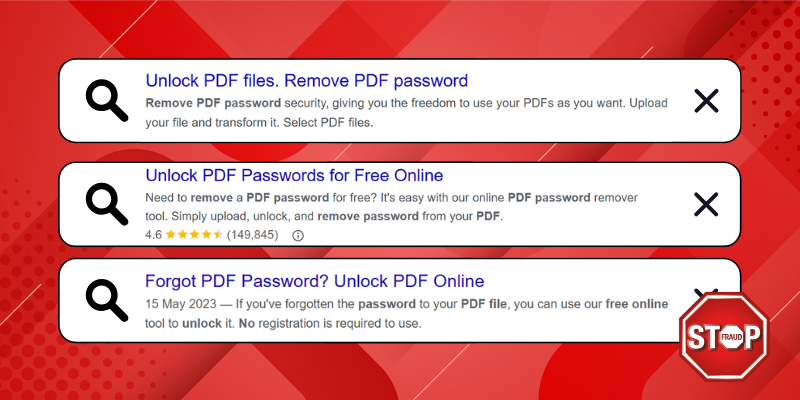
A search into Google for “PDF password remover” returns 7,710,00 search results (as of September 2024). One of the search results reads “Need to remove a PDF password for free? Simply upload, unlock, and remove the password from your PDF.”
Furthermore, the popularity and ubiquity of the PDF format have led to its exploitation by fraudsters and criminals, and malicious PDF files have been at the centre of several cyberattacks.
Research from Check Point found that PDFs account for 22% of malicious email attachments and are increasingly being used to distribute phishing links, malware and other cyber threats.
These included a Facebook con to trick job seekers into infecting their PCs with software that steals their credit card data and passwords, and Russian hackers using encrypted PDFs to spread malware.
While these attacks are not directly related to academic credentials, they highlight a broader challenge that PDFs are designed to be highly shareable and widely accessible – characteristics that can be exploited for fraud.
Institutions that place a high priority on document integrity and security should carefully consider whether PDFs alone provide sufficient protection against fraud.
Protecting you from PDF credentials fraud
For institutions, maintaining trust in digital credentials requires more than simply distributing documents electronically. It requires technologies that allow achievements to be securely accessed, viewed, shared and verified within a controlled environment.
Modern digital credentialing platforms like Digital Certificates® address many of the limitations associated with PDFs by enabling:
- Secure platform access – helping verify that the person accessing the credential is the legitimate holder.
- Secure and instant verification – confirming both the authenticity of the credential and its issuing institution.
- Greater issuer control – maintaining oversight of credentials after issuance, with the ability to manage access, revoke awards where necessary and eliminate unauthorised sharing
- Advanced audit tracking
Conclusion
Digital transformation has created new opportunities for institutions to modernise the way qualifications are issued and shared. However, not all digital formats provide the same level of protection against the rising risks of fraud.
While PDFs remain useful for many areas of business, their susceptibility to editing, unclear verification processes and loss of issuer control can create significant risks for institutions seeking to protect the value of their awards.
Our Digital Certificates® platform enables institutions to issue secure Blockchain Documents® within a secure environment hosted on the institution’s domain. This provides greater control over access and verification, helping to stop fraud, protect institutional reputation and maintain trust in qualifications long after they have been awarded.